


Key findings
The Supreme Court ordered customs to refund the tax Adani Power paid on Mundra electricity from September 2010 to February 2016.
Its reason: a rule already makes Adani pay the duty on its coal, so taxing the power too “is to double count”.
A government order had switched that rule off from 6 September 2010. The judgment never mentions it.
A Rs 963.94 crore coal duty demand for 2009-10 to 2014-15 is still open, with nothing paid under protest.
“Is to double count”
On 5 January 2026, Justices Aravind Kumar and N.V. Anjaria of the Supreme Court signed a 33-page judgment in favour of Adani Power. Customs was to hand back the tax the company had paid on electricity sent from its Mundra plant into the rest of India. The refund covers 16 September 2010 to 15 February 2016, and was due within eight weeks.
The government had defended that tax as a way to recover the benefit of duty-free inputs “such as imported coal”. The judges disagreed. A rule of the special economic zone, they wrote, “already obliges” the plant to pay back the duty on its inputs when its power leaves the zone. To tax the electricity on top “is to double count”.
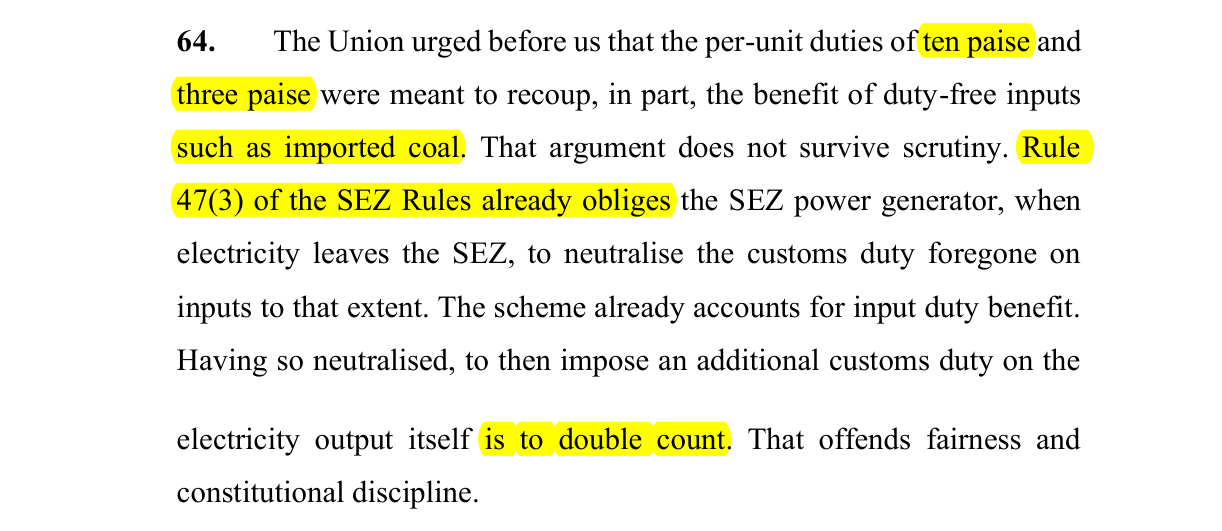
Supreme Court judgment of 5 January 2026, para 64: the rule “already obliges” Adani Power, so taxing the power “is to double count”.
But for the years the court was refunding, that rule had been switched off. On 28 October 2010 the Department of Commerce issued an order one sentence long. It reads: “Operation of Rule 47(3) of SEZ Rules, 2006 is kept abeyance w.e.f. 6.9.2010 till further orders.” Rule 47(3) is the rule the judges relied on. It stopped running on 6 September 2010, ten days before the refund period begins.
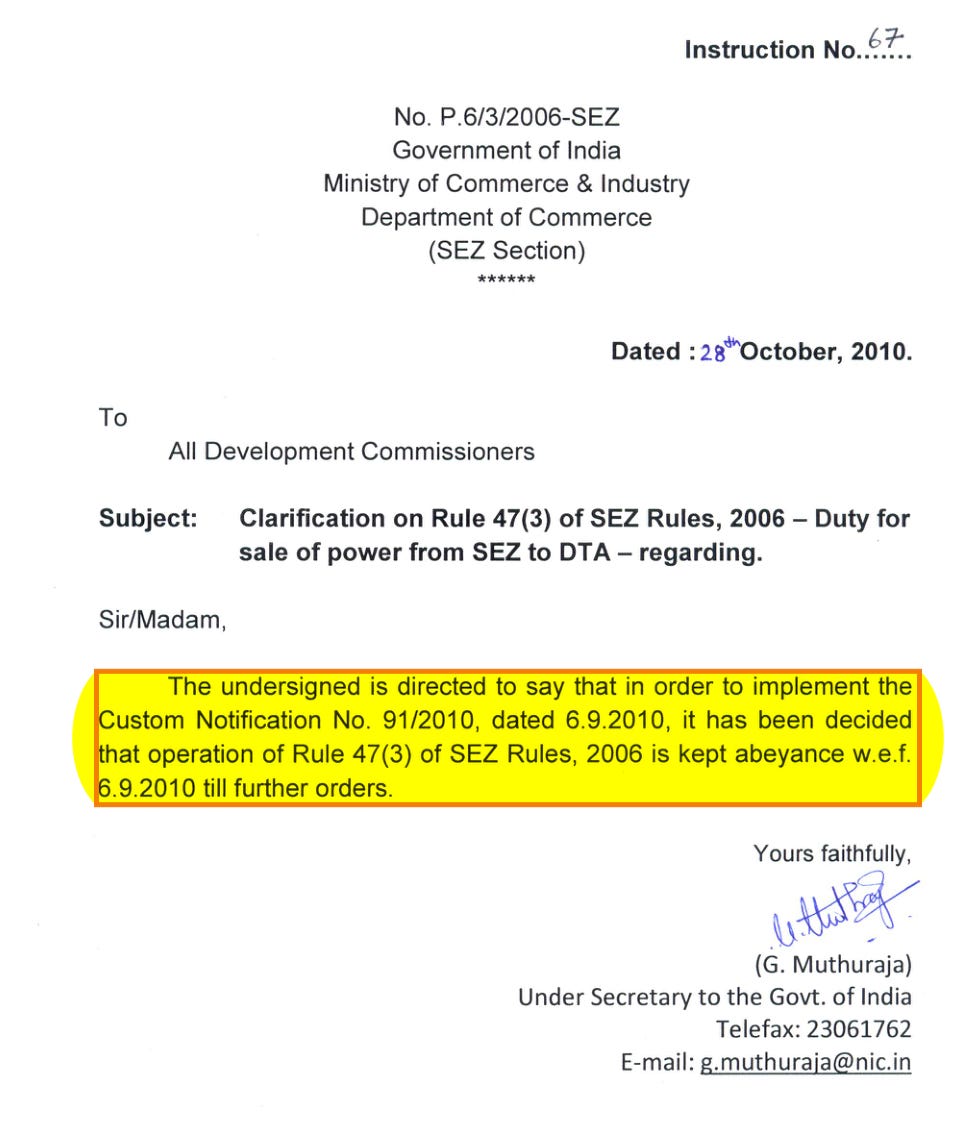
The one-sentence order that suspended the coal duty rule from 6 September 2010. Department of Commerce, 28 October 2010.
The judgment reproduces Rule 47(3) in full, with no word that it had been suspended. The words “instruction” and “abeyance” appear nowhere in its 33 pages, and neither does the Commerce Department.
So the court refunded one tax on the strength of another that the government had stopped collecting. Adani Power belongs to the Adani Group, which OCCRP reported in 2023 is widely perceived as close to Prime Minister Narendra Modi. Its counsel in the Supreme Court was P Chidambaram, the former finance minister.
How much was paid back is not stated in the judgment or in Adani Power’s latest annual report. In 2014-15 alone, the company booked Rs 86.94 crore of customs duty on its electricity.
Two taxes, one switched off
The Mundra plant sits inside a special economic zone on the Gujarat coast, so its imported coal arrives free of customs duty. Power used inside the zone keeps that benefit. For power sold to the rest of India, the rules required the plant to pay the duty “on consumables and raw materials used for generation of power”. For a coal plant, that is the duty on its coal.
In February 2010 the government added a second charge: 16% on the power itself, backdated to June 2009. Adani Power went to the Gujarat High Court and called it double taxation.
Then the government changed course. From 16 September 2010 the 16% gave way to ten paise a unit, later cut to three paise. Ten days before that, the coal duty rule had been switched off. A second order in February 2011 narrowed the suspension, but the clause on duty for power sold into India stayed off.
For five and a half years the coal duty was off and a small power tax was on. In February 2016 the power tax went to nil for plants like Adani’s.
The order that dropped out
In July 2015 Adani Power won its first case. The High Court struck down the 16%, but only for June 2009 to September 2010, when both taxes had run together.
The company then went after the small power tax as well, every paisa from September 2010 to February 2016. On 28 June 2019 the High Court refused. The government’s lawyer had put the 2010 order before the judges. With the coal duty off since 2010, he argued, a refund would hand Adani a “double benefit”. Counsel for another respondent said the rule had “been kept in abeyance for a period of five years”.
In the Supreme Court the order fell out of view. The judgment’s account of the government’s arguments does not mention it. Its summary of the 2019 ruling leaves out the double benefit.
Chidambaram told the judges there had been “no change in the law or in the underlying facts” between September 2010 and February 2016. The court agreed, finding “no change either in the law or in the relevant facts”.
That finding carried weight. The court held that the 2015 ruling covered the later years only in the “absence” of a change in the legal setting. The 2010 order was such a change, and it suspended the very rule the double count rests on.
Liable, paid, not required
Did Adani Power pay the coal duty? Its answer has moved with the case.
In 2010, fighting the 16%, it told the High Court it would “continue to be liable” for duty on its coal. By 2015 the same court recorded its case as having “already paid duty on raw materials, namely, coal”. The government’s lawyer described a letter the company sent in September 2015. In it, Adani Power put the duty benefit it had taken at Rs 963.94 crore and the duty it had paid at Rs 458.50 crore.
In June 2017 the group gave another answer. Asked by the Economic and Political Weekly about its tax benefits, the Adani Group’s chief legal officer wrote: “we are not required to pay any duty/levy on the goods imported/procured in SEZ”.
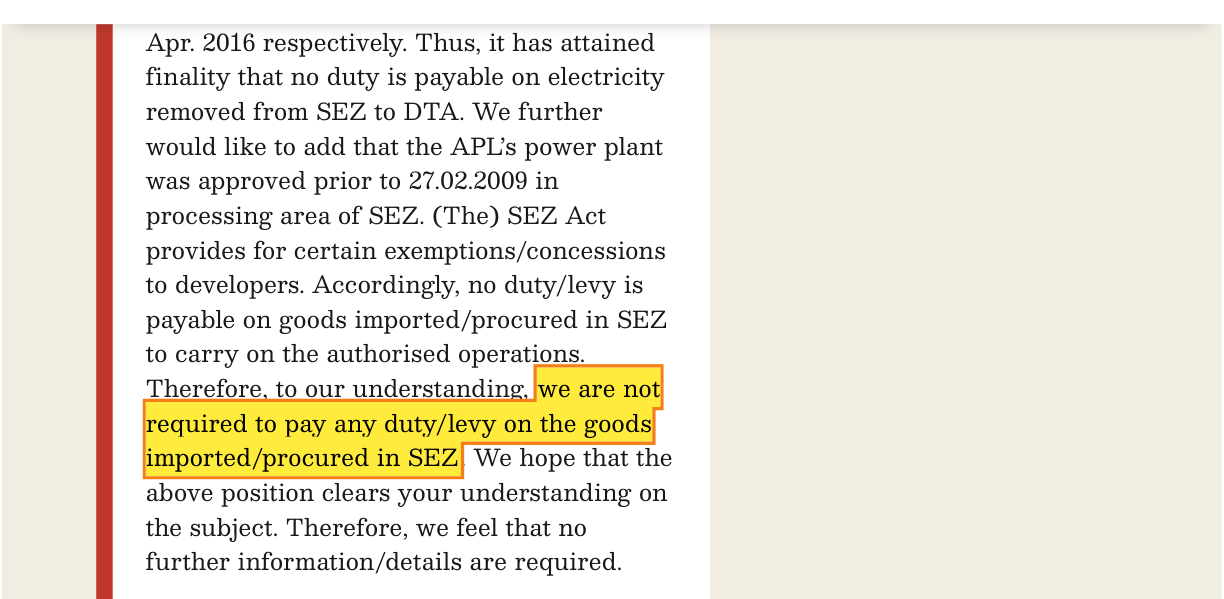
The Adani Group’s chief legal officer to the Economic and Political Weekly, June 2017, as republished by The Wire.
The bill still open
Since 2017-18, Adani Power’s annual reports have disclosed a demand from the Development Commissioner of the Mundra zone. It is for duty on raw materials used for power sold outside the zone, covering 2009-10 to 2014-15. The amount is Rs 963.94 crore, and the company is contesting it. That is the same figure as the duty benefit in its 2015 letter. The 2018-19 report called it “custom duty on coal”.
So the government suspended the coal duty from September 2010, then demanded it for years that include the suspension. The Supreme Court refunded the power tax as though the duty had applied throughout.
The company has also said who would carry the cost if it lost. Its reports describe such duties as “eligible to be made good” under its power purchase agreements with distribution companies. Every report from 2017-18 to 2025-26 repeats the line. Since 2022-23 the reports add that the company has “not considered this as contingent liabilities”, meaning it does not list the demand even as a possible bill.
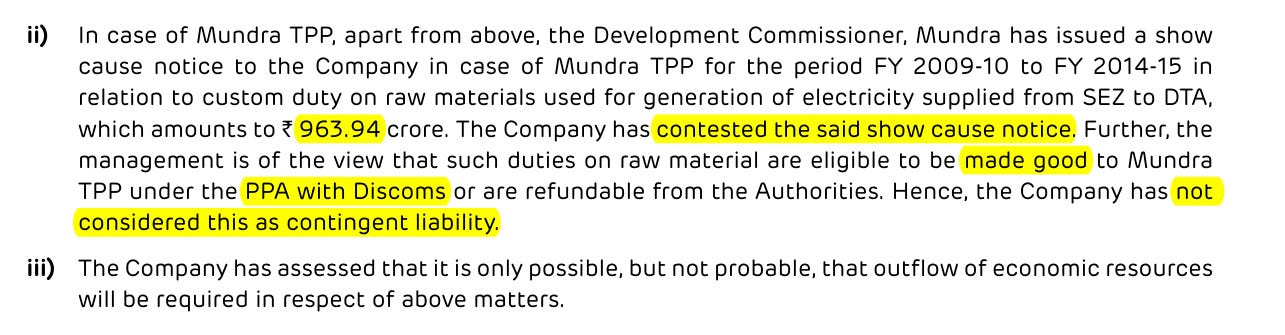
Adani Power annual report 2025-26, note 45: the Rs 963.94 crore coal duty demand, and the view that it can be made good under power contracts.
On 31 March 2026, three months after the Supreme Court ordered the power tax refunded, the auditor’s list of disputed dues still showed the Rs 963.94 crore coal duty pending before the Development Commissioner. Nothing had been paid against it under protest.
The documents this story is based on, the clearances, orders, agendas and filings, are collected in one place.
→ The documents behind this story — add your DocumentCloud link