


Key findings
Two Mauritius funds held up to 3.90% of four Adani companies from 2013 to 2018, counted as public shares.
Counted with the promoters, they would have pushed two of the companies below the 25% public floor in March 2017.
SEBI holds that Vinod Adani was in “de jure control” of the adviser hired for the funds’ main investors, yet finds “no footprint” of him in their investments.
The companies settled at 6:04 pm on 28 September 2026. At 7:37 pm the same SEBI member ruled the breach “not established”.
Ninety-three minutes
At 6:04 pm on 28 September 2026, Kamlesh Chandra Varshney, a whole-time member of the Securities and Exchange Board of India (SEBI), digitally signed a settlement order. Adani Enterprises, Adani Power, Adani Ports and Adani Transmission had each paid Rs 37,05,000, jointly with their directors, Gautam Adani among them. They paid “without admitting or denying the facts and conclusions of law”.
At 7:37 pm Varshney signed the final order in the same case. The companies’ breach of the public shareholding rule, it ruled, was “not established”. Its second page still reads “settled vide order dated [Insert Order date]”. Nobody had filled it in.
But the order also records what its verdict leaves out. “I hold that the Noticee no. 1 was in de jure control of ARFT,” Varshney wrote. Noticee no. 1 is Vinod Adani, Gautam Adani’s elder brother. ARFT is his family trust in the Cayman Islands. It owned Excel Investment and Advisory Services, the firm hired to advise on the money behind two funds that held Adani shares as members of the public.
The next paragraph begins: “Having concluded that Mr. Vinod Adani effectively controlled Excel.” De jure means by law.
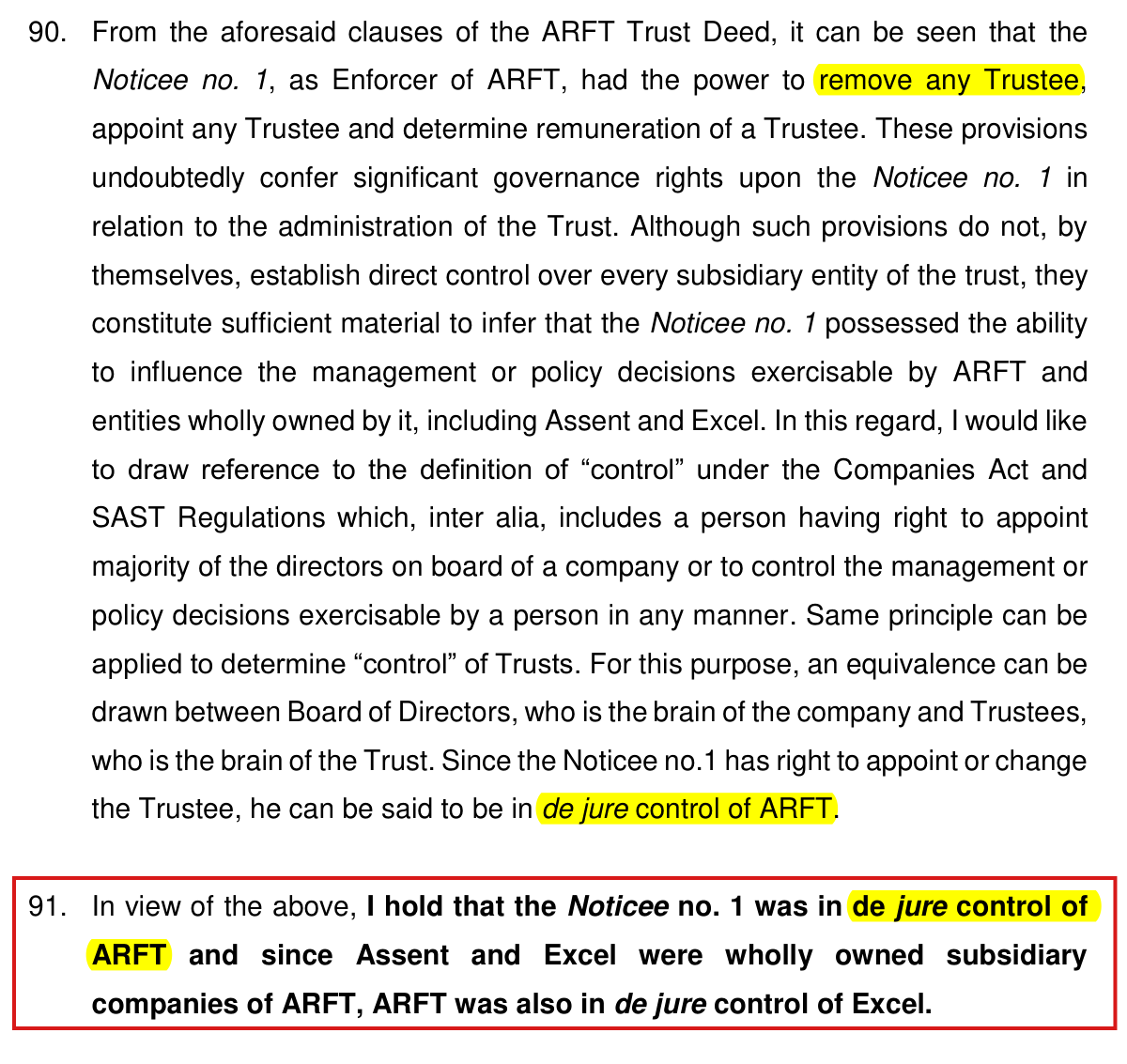
Varshney’s finding that Vinod Adani was in de jure control of the trust that owned Excel. SEBI final order, page 38.
That was the heart of the charge. SEBI’s investigators had alleged that the shares counted as public were bought at Vinod Adani’s direction and controlled by him. These are the companies of a group “widely perceived” as close to Prime Minister Narendra Modi, as a 2023 OCCRP investigation put it.
A line at 25%
Every listed company in India must keep at least a quarter of its shares with the public. Its promoters, meaning the founding family and the companies it controls, may hold no more than 75%. The point, the order says, is “price discovery through market participation”.
From 2013 to 2018, two Mauritius funds, Emerging India Focus Funds (EIFF) and EM Resurgent Fund (EMR), sat on the public side of four Adani companies. At their peak they held 3.90% of Adani Power, 3.77% of Adani Transmission, 3.38% of Adani Enterprises and 2.99% of Adani Ports.
Small stakes, but they sat right on the line. In March 2017 Adani Transmission reported its promoters at 74.92% and the public at 25.08%, with EIFF at 2.47% and EMR at 1.17%. Move the two funds to the promoter side and the public falls to 21.44%. Adani Enterprises, in the same quarter, falls from 25.08% to 22.57%.
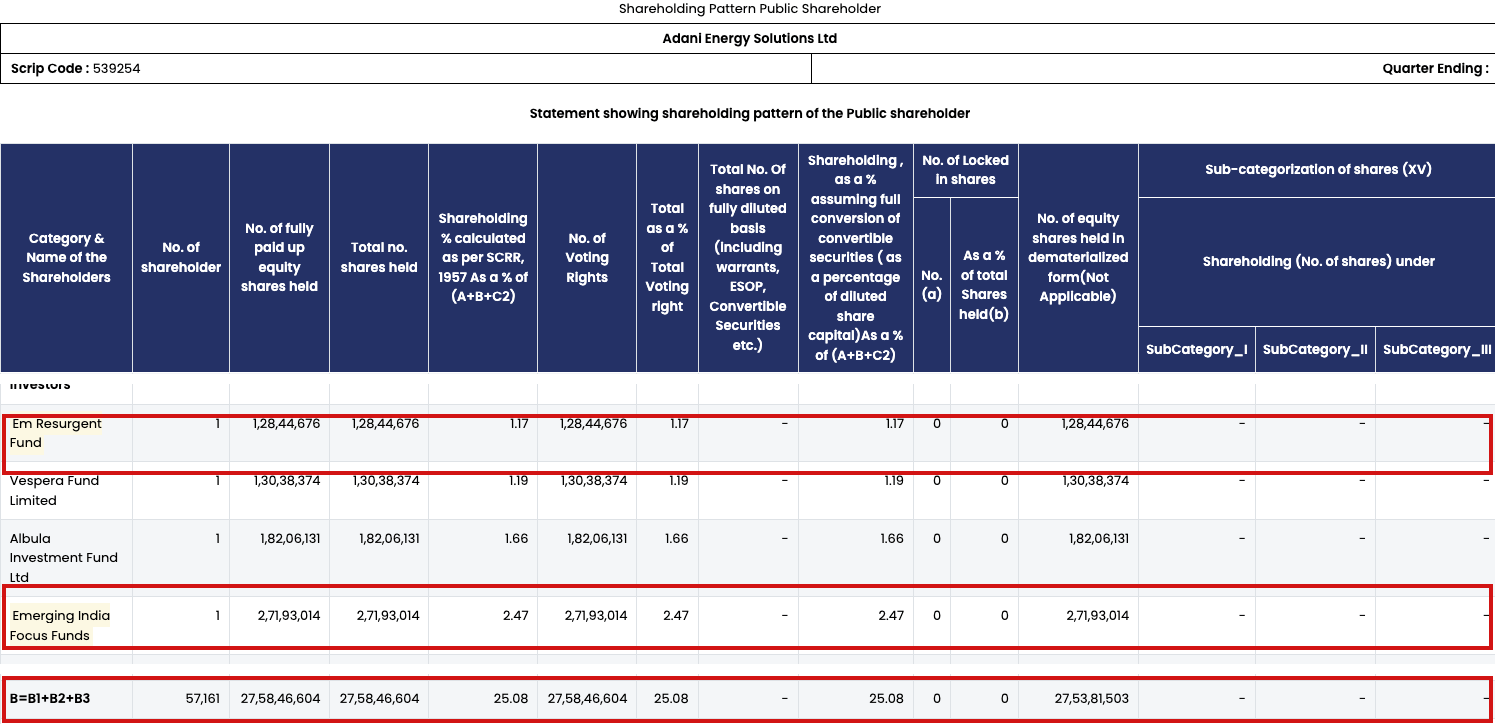
Adani Transmission’s public shareholders in March 2017, with the two funds at 1.17% and 2.47% and the public at 25.08%. BSE shareholding pattern.
Below the line, SEBI’s own 2017 rules bite. The stock exchange fines the company Rs 5,000 a day, rising to Rs 10,000 a day after a year, and freezes every share the promoters hold. It “may also consider compulsory delisting”.
The money behind the funds
SEBI opened its investigation on 23 October 2020 and traced the funds’ money back to its start.
It began with Daboul Trading, owned by the Emirati businessman Nasser Ali Shaban Ahli. On 1 September 2010 Daboul lent $350 million to Lingo Investment, which the Taiwanese businessman Chang Chung-Ling had set up eight days earlier. In May 2011 Daboul lent $400 million to a company Ahli had set up six days before. Two more Ahli companies made four investors.
The four put their money into Global Opportunities Fund in Bermuda, which invested through EIFF and EMR. The Bermuda fund had 478 investors. By the investigators’ count, these four supplied 99.49% of EIFF’s Adani money and 99.79% of EMR’s. Together the two funds put about Rs 3,302 crore into the four Adani companies.
From 1 April 2012 the fund’s manager hired Excel to advise on investments for three of the four. The contract also let Excel advise, on written request, “whether and in what manner the rights conferred by the investments shall be exercised”. In plain words, how to vote the shares. Vinod Adani was the settlor, enforcer and beneficiary of the trust that owned Excel, and could remove its trustee.
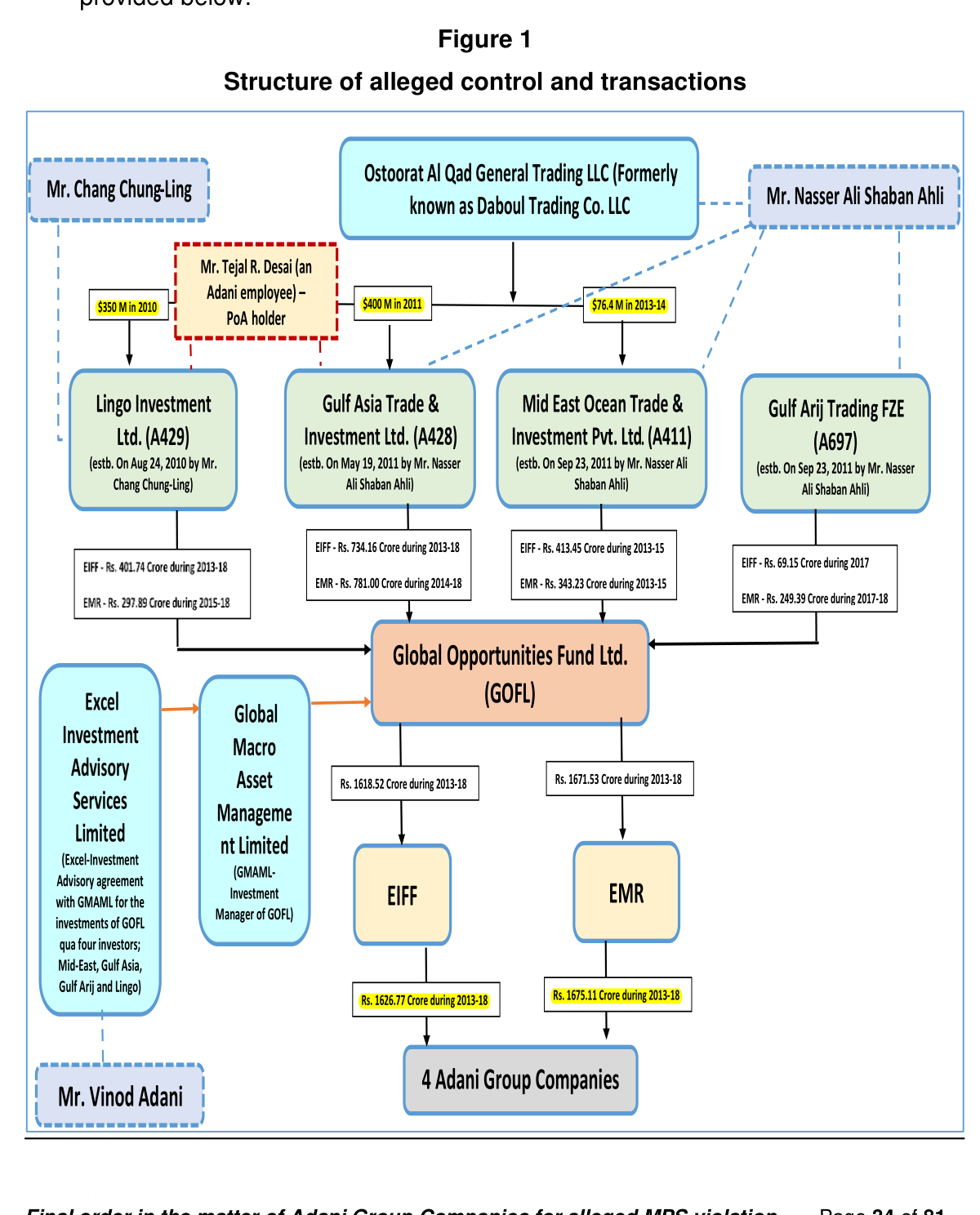
SEBI’s own chart of the structure, from Daboul’s loans through the Bermuda fund to the four Adani companies, with Excel and Vinod Adani beside the fund manager. SEBI final order, page 34.
What SEBI ruled, and what its order records
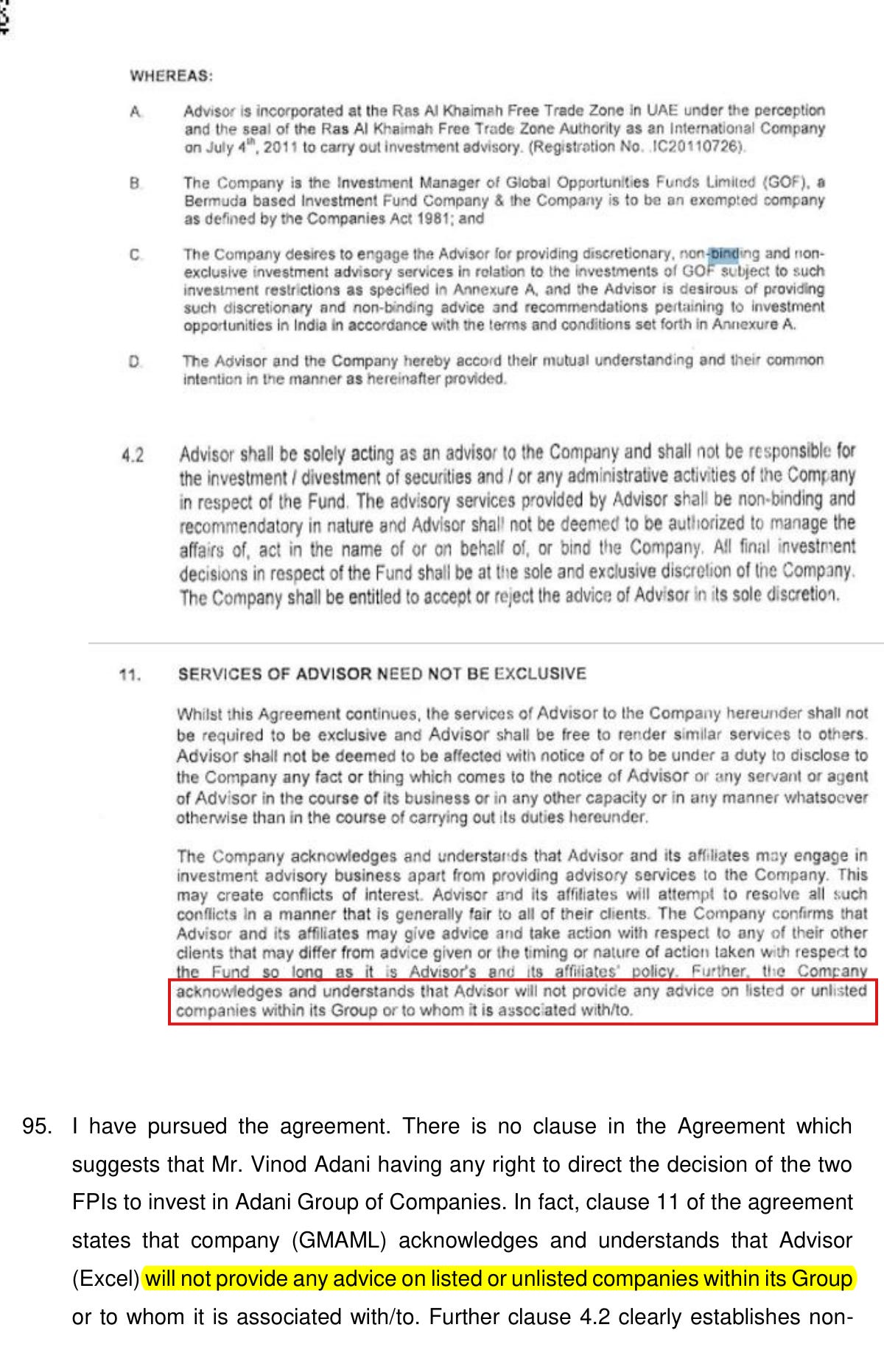
SEBI accepted that Vinod Adani controlled Excel. Then it read the contract. Excel’s advice was “non-binding”, and one clause said Excel would not advise on companies “within its Group or to whom it is associated with/to”. The investigators had not discussed these clauses, the order says, so “the alleged chain of control substantially breaks at this stage”. It does not ask whether a firm owned by an Adani brother’s trust was associated with Adani companies.
It went further. “There is also no footprint of him being involved in the decision” of the two funds to invest in Adani companies, the order says. OCCRP had reported in 2023 that Vinod Adani himself signed, for Excel, an agreement to advise EIFF and EMR. The funds’ managers paid Excel over $1.4 million in fees between 2012 and 2014.
SEBI’s finding of “no footprint” of Vinod Adani in the funds’ decision to invest. SEBI final order, page 42.
The funds voted with the promoters on related-party deals and on reappointing promoter directors. That “voting alignment”, the order held, could not “by itself establish control”.
The two men behind the money were fined Rs 20 lakh each. Ahli did not answer SEBI’s summons. Chang told SEBI he had no connection with the Adani promoters, though the investigators alleged he and Vinod Adani had sat together as directors of Adani Global from 1997 to 2008. The order calls his denial, with his failure to say where his money came from, a “deliberate attempt to mislead investigation”. Their ties to Vinod Adani, it says, “would only establish close business and financial relationship”.
The order rests on a legal test. Control means the power to “positively direct” a company’s decisions, and proving it was the investigators’ job. Nobody has shown where the money started. OCCRP found no evidence that it came from the Adani family, but found that Vinod Adani used the same Bermuda fund and EIFF for his own investments.
And SEBI’s charge sheet, the show cause notice, never claimed the money was his. It “does not allege that Mr. Vinod Adani is the beneficial owner” of the funds’ investments, the order says. That “could have been alleged”. “If that had been the allegation and there were evidences to prove the same, the situation could have been different.”
The price of a breach not established
The investigators put the wrongful gains earned through the structure at Rs 1,983.97 crore. The order held those gains not established. SEBI says a “sufficiently higher settlement price” deters wrongdoing. It took Rs 37,05,000 from each company for a breach that, in its own words, “does not stand established”.
The next day Adani Enterprises told the stock exchanges that the settlement had “no material financial impact”.
The order finds that the facts “may legitimately give rise to suspicion warranting further examination.” Its directions order none.
The documents this story is based on, the clearances, orders, agendas and filings, are collected in one place.
→ The documents behind this story — add your DocumentCloud link