


Key findings
On 18 May 2026, Uzbekistan’s energy minister met Adani’s international energy chief, Amit Singh, in Tashkent.
The joint statement Modi signed on 30 August repeats that meeting’s readout in the same order, with two changes.
Adani met Uzbek ministers or state companies six times before Modi arrived, the last on minerals twelve days before a geology pact.
No visit document names Adani, and no signed Adani deal in Uzbekistan is on the public record.
Two sentences, three months apart
On 30 August 2026, Narendra Modi and Shavkat Mirziyoyev closed a two-day state visit in Tashkent. They signed eleven documents and issued a joint statement.
Under the heading on energy, the two leaders gave one sentence:
“The Leaders welcomed the discussions on advancing cooperation in the fields of renewable energy, modernization of energy infrastructure, and the implementation of prospective investment projects.”
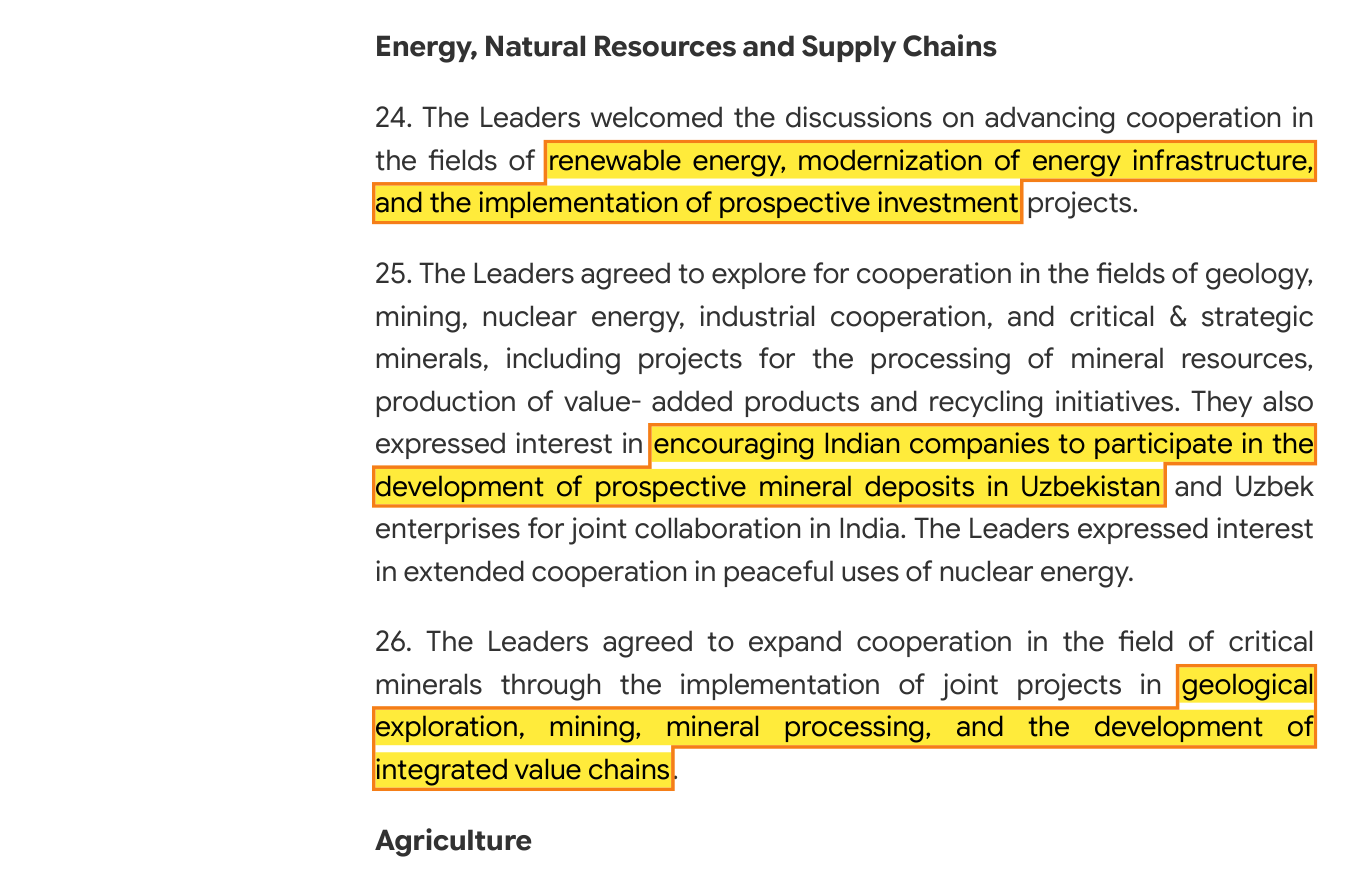
The joint statement’s energy and minerals passages. Source: Ministry of External Affairs, Joint Statement, 30 August 2026.
It welcomes “the discussions” without saying whose. But the same words had been printed three months earlier, about a meeting with the Adani Group.
On 18 May, in Tashkent, energy minister Jurabek Mirzamakhmudov met Amit Singh, who runs international energy for Adani. The next day the state newspaper Yangi O’zbekiston published the official account in English:
“During the talks, the parties discussed the development of renewable energy sources, modernization of energy infrastructure, increasing the efficiency of the industry, as well as the implementation of promising investment projects.”
Renewable energy, then modernization of energy infrastructure, then the implementation of investment projects. The order and the nouns are the same. In three months only two things changed: “the efficiency of the industry” dropped out, and “promising” became “prospective”.
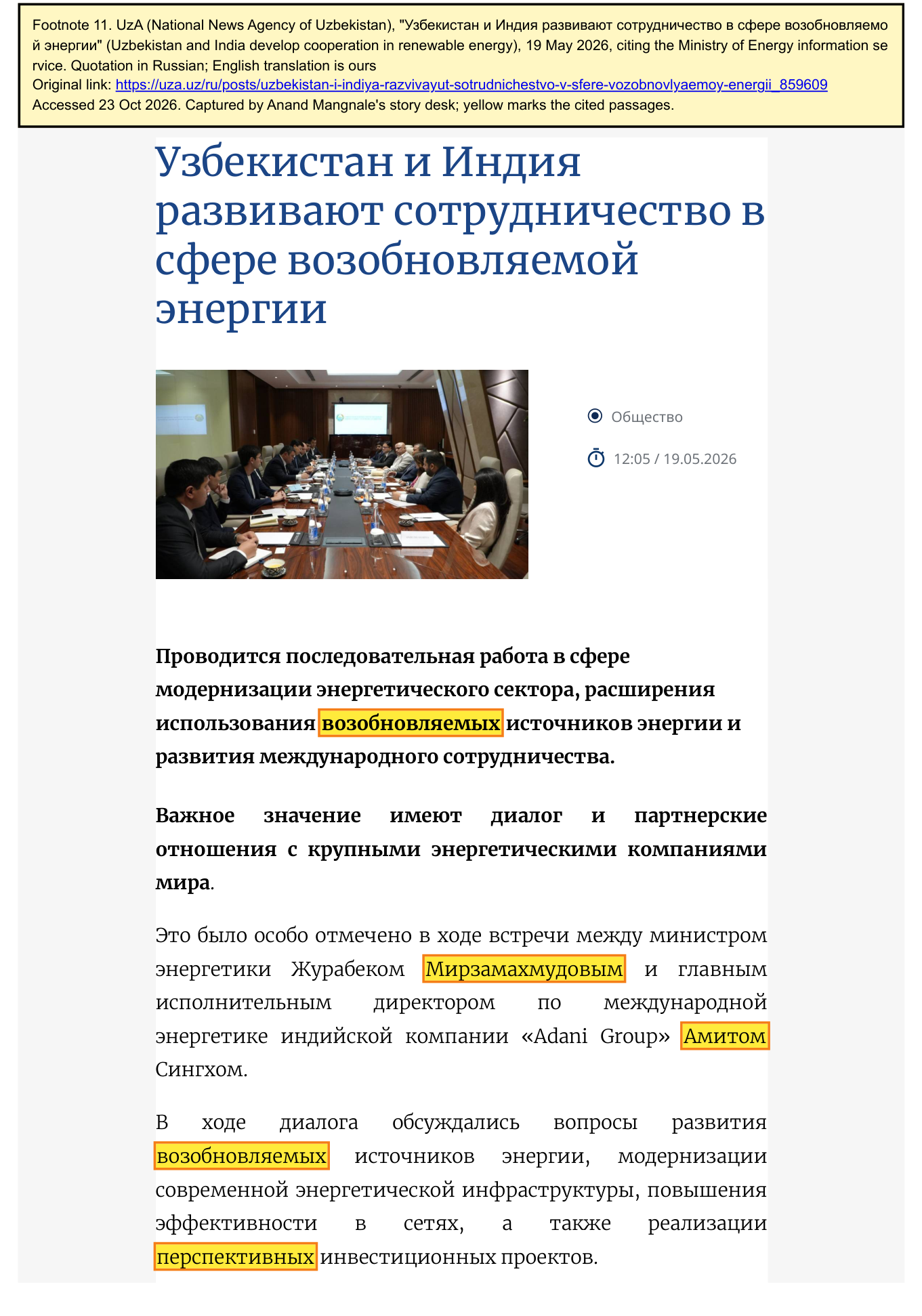
The national news agency’s report of the 18 May meeting, citing the energy ministry, with the minister’s and Singh’s names marked. Source: UzA, 19 May 2026.
A summer of meetings
The energy minister was only the first. The next day, 19 May, investment minister Laziz Kudratov met Singh. The government portal says Adani was “presented with promising project proposals” in hydropower, mining, infrastructure and real estate. Both sides agreed “to jointly advance prospective projects and establish mechanisms for further collaboration”.
Two days later the private outlet UzDaily reported that Deputy Prime Minister Jamshid Khodjaev had met Singh. They went over energy, chemicals, mining and critical minerals, it said, citing Khodjaev.
In June the state hydropower company, Uzbekhydroenergo, took its turn at the Tashkent International Investment Forum. It reported that “an agreement was reached” with Adani “to establish a joint working group and to implement promising projects”.
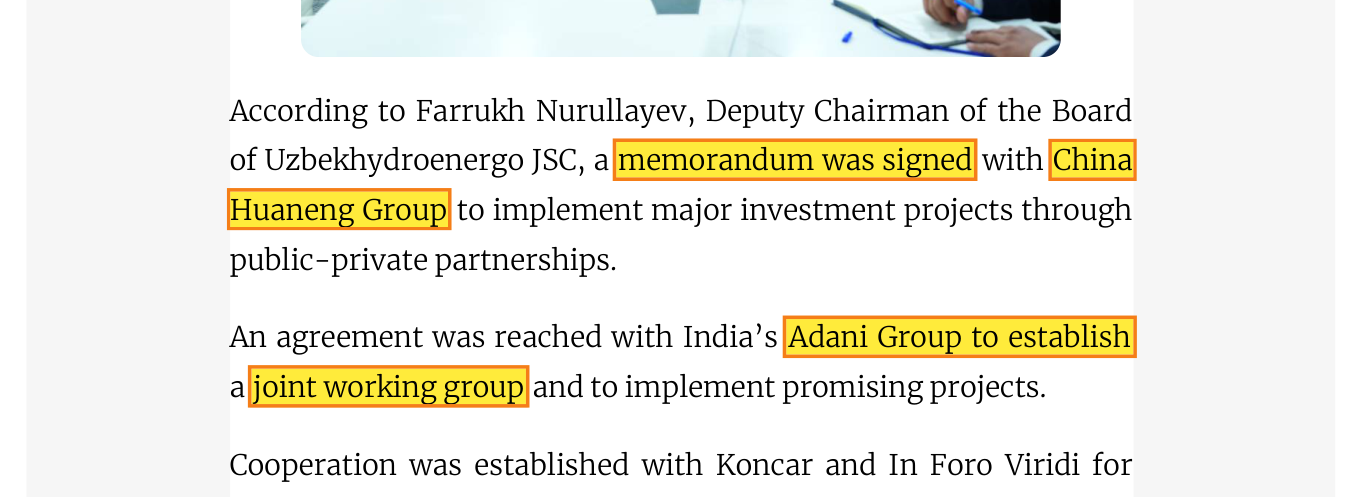
At the June forum, China Huaneng signed a memorandum; Adani got a working group. Source: UzA, 21 June 2026.
On 10 August the talks moved to Adani’s home city. A delegation led by Kudratov met the Adani Group in Ahmedabad. The national news agency UzA quoted Gautam Adani saying the group was “highly interested” in building hydropower and pumped-storage plants in Uzbekistan.
The metals company
Eight days later came the state metals company. The Uzbekistan Technological Metals Complex, known as TMK, was set up by presidential decree to process metals such as lithium, graphite and tungsten. It belongs to a national plan of 120 critical minerals projects worth $4.2 billion, on which the president was briefed in June.
On 18 August TMK met the Adani Group. Its statement, quoted by the Azerbaijani agency Trend, said the two sides discussed TMK’s mining projects, “studying the available geological and technical data” and more exploration. TMK also laid out “a pipeline of potential investment projects”.
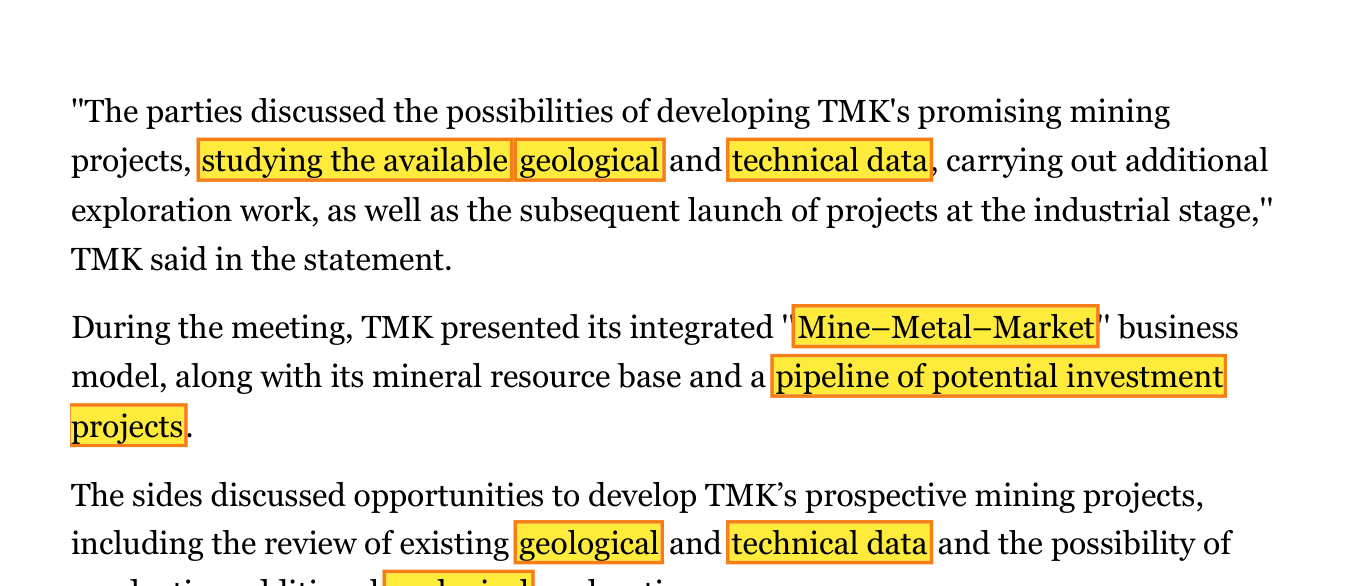
Trend’s report of TMK’s statement on the Adani meeting. Source: Trend News Agency, 18 August 2026.
Modi landed eleven days later. Among the eleven documents signed on 30 August was a memorandum on geology and mineral resources between India’s Ministry of Mines and Uzbekistan’s Ministry of Mining Industry and Geology.
The joint statement then went over the ground TMK had covered. The leaders “expressed interest in encouraging Indian companies to participate in the development of prospective mineral deposits in Uzbekistan”. They agreed on joint projects in “geological exploration, mining, mineral processing, and the development of integrated value chains”.
Another of the eleven documents paired the Indian state of Gujarat with the Samarkand region. Ahmedabad, where Kudratov’s delegation met Adani, is in Gujarat.
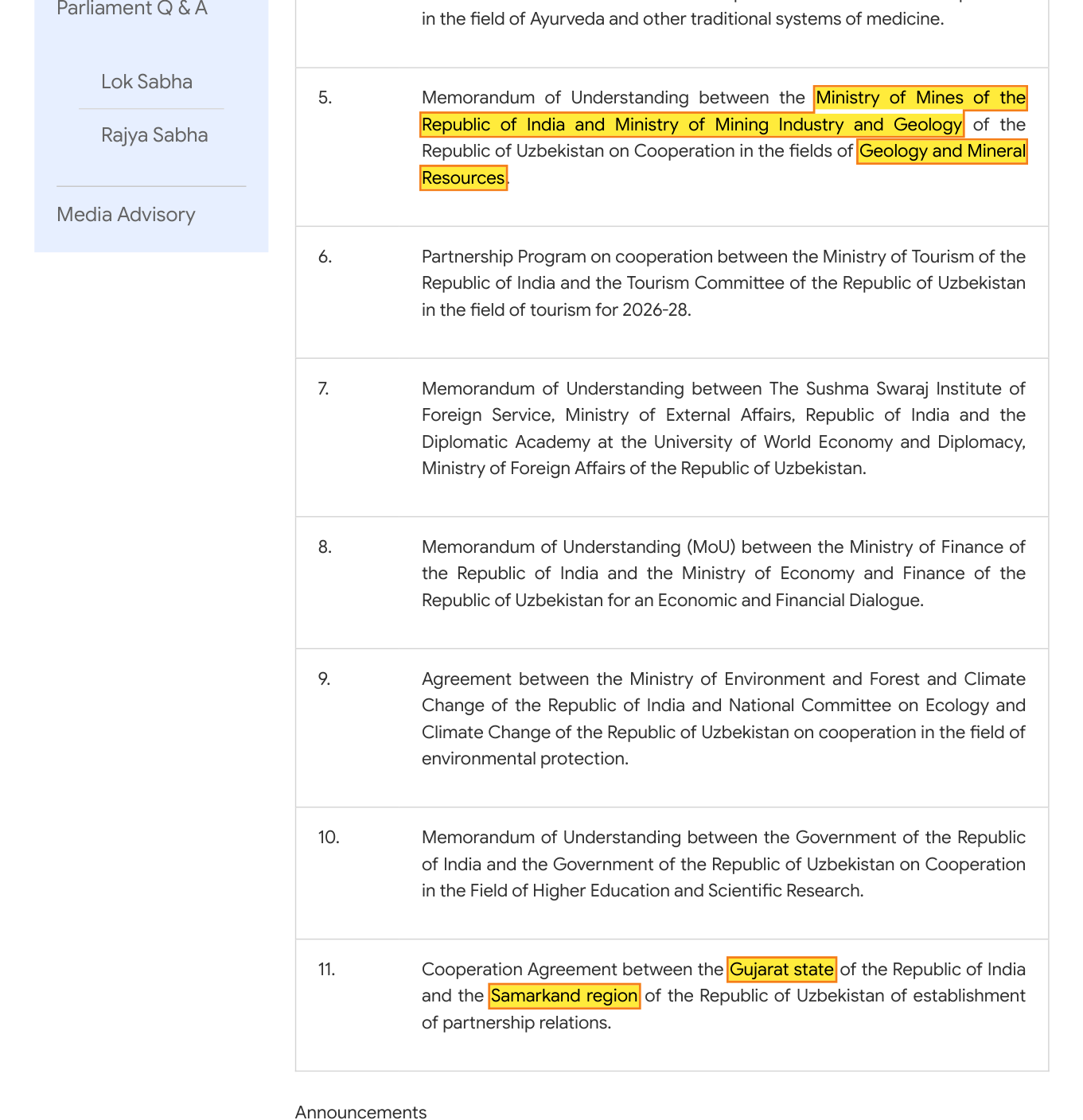
India’s list of outcomes from the visit, items 5 and 11 marked. Source: Ministry of External Affairs, 30 August 2026.
What the record leaves out
Adani’s name appears in none of it. None of the eleven documents on India’s list mentions the group, and the joint statement speaks of Indian companies in the plural.
Uzbekistan courts many investors at once. At the June forum Uzbekhydroenergo met nine parties, among them China Huaneng, MUFG and the World Bank. China Huaneng signed a memorandum there, while Adani got a working group. In the same round Khodjaev also saw AD Ports Group and a German cable maker.
Nor is there a deal. A search of Uzbek and Indian official sources found talks, project proposals, a working group and stated interest. It found no signed Adani contract, licence or joint venture in Uzbekistan.
What the record does hold is the order of events and the wording. A group widely seen as close to the Prime Minister sat with Uzbekistan’s energy, investment and metals officials through the summer. Then the two leaders signed off on cooperation in the same fields, in nearly the same words.
After Ahmedabad, UzA reported, both sides agreed to keep going “by establishing strong project partnership mechanisms”. The leaders set up a mechanism of their own, led by their foreign ministers, to oversee “priority bilateral initiatives and projects”.
As of 23 October 2026, the text of the geology memorandum has not been published. Neither government has said whether any other Indian company was shown TMK’s geological data.
The documents this story is based on, the clearances, orders, agendas and filings, are collected in one place.
→ The documents behind this story — add your DocumentCloud link