


Key findings
In April 2021 Maharashtra’s environment authority ruled the jetty and plant “cannot be treated as independent projects”.
The environment ministry cleared them through two committees, almost nine months apart, and filed the plant in a state-level category.
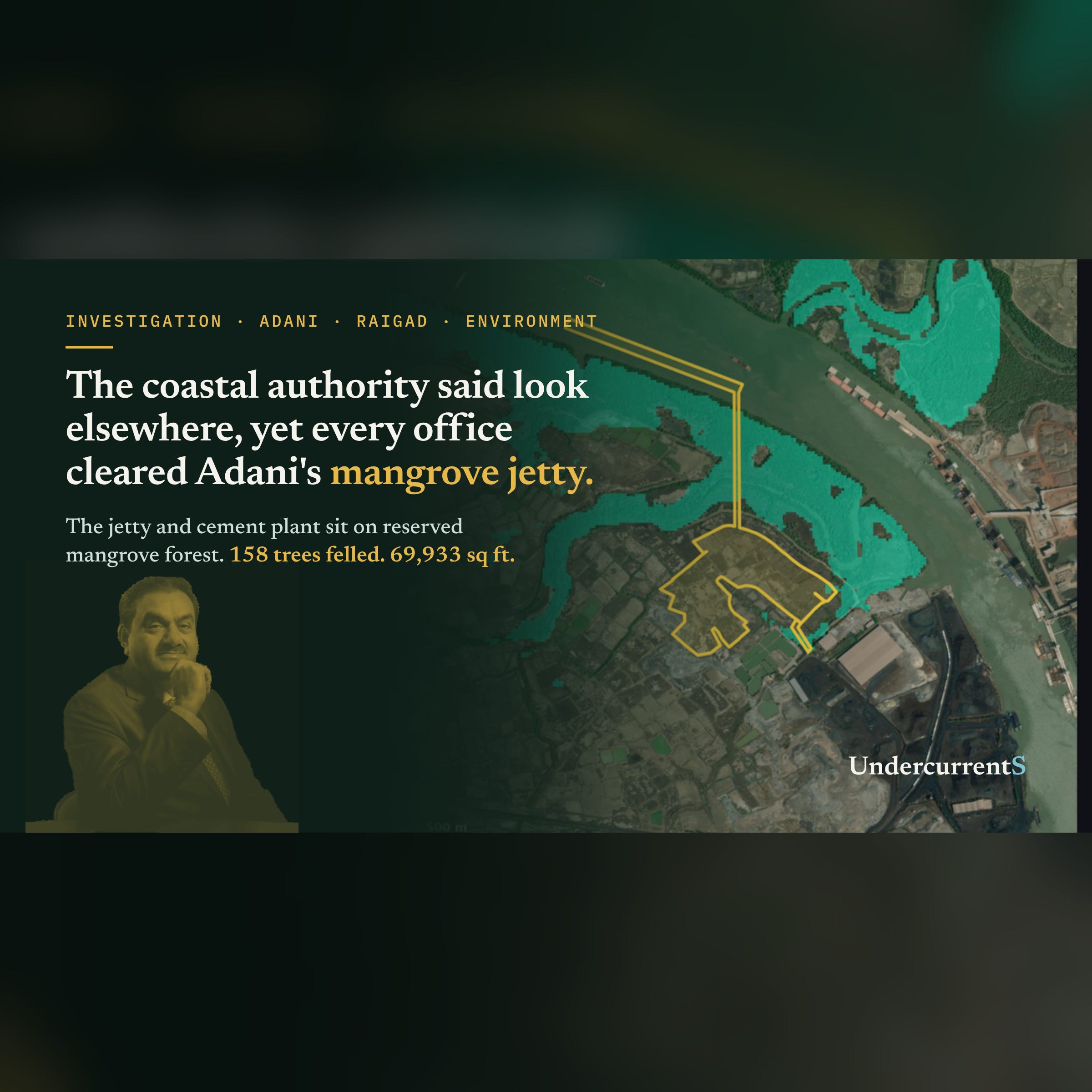
The plant’s papers record no forest land. The jetty takes 0.6497 hectares of mangrove reserved forest.
The coastal authority told the company to look for another site because of the mangroves, then recommended the same one.
One project, in the state’s words
On 23 April 2021, Maharashtra’s State Environment Impact Assessment Authority sent its answer to Adani Cementation Ltd. The company had brought it a cement grinding unit at Shahbaj, near Alibag in Raigad district, as a standalone plant of the kind the state clears on its own.
The authority refused to see it that way. The plant and the company’s planned jetty on the Amba river “are interdependent activities”, it wrote, and “cannot be treated as independent projects”.
It told the company to take both to the environment ministry in Delhi “as an integrated project”, in Category A. That is the class reserved for projects with the widest impact, which the centre must judge as a whole.

The state authority’s ruling, as the plant’s environmental clearance of 13 September 2024 quotes it.
But Delhi split the file. On 29 December 2023 the ministry cleared the jetty on the advice of its infrastructure committee. On 13 September 2024, almost nine months later, it cleared the plant on the advice of a separate committee for industry.
The summary box on the plant’s clearance records it as Category B1, a state-level class. The state had asked for one file in the top category. It got two letters, and one of them still carries a B.

The category box on page 1 of the plant’s environmental clearance, 13 September 2024.
The split decided what each letter had to look at. Read alone, the plant’s papers say “No involvement of Forest Land” and record no water body within the site.
The jetty, cleared on the same impact study, stands in the Amba estuary and takes 0.6497 hectares of mangrove reserved forest, about 69,933 square feet. Everything that touched the river went into one letter. The plant the jetty exists to serve arrived in the other looking clean.
The company belongs to the Adani Group, whose “widely perceived closeness to Prime Minister Narendra Modi” OCCRP has described. The creek it is building on feeds fishing families from Shahbaj, Shahapur and Dhamanpada. Among the cargo the jetty is cleared to handle is coal.
The site that never moved
The April 2021 ruling was the second warning a Maharashtra authority had given. The first came from the coastal regulator, nine months before it.
In October 2019 the state’s mangrove cell inspected the land the jetty would cross. It found “a dense mangrove dominated by Avicennia marina”, the grey mangrove, on plots listed as reserve forest.
On 7 July 2020 the Maharashtra Coastal Zone Management Authority decided the company “need to explore other site for the project activities”. The reason it gave was “the existence of mangroves at the site”.
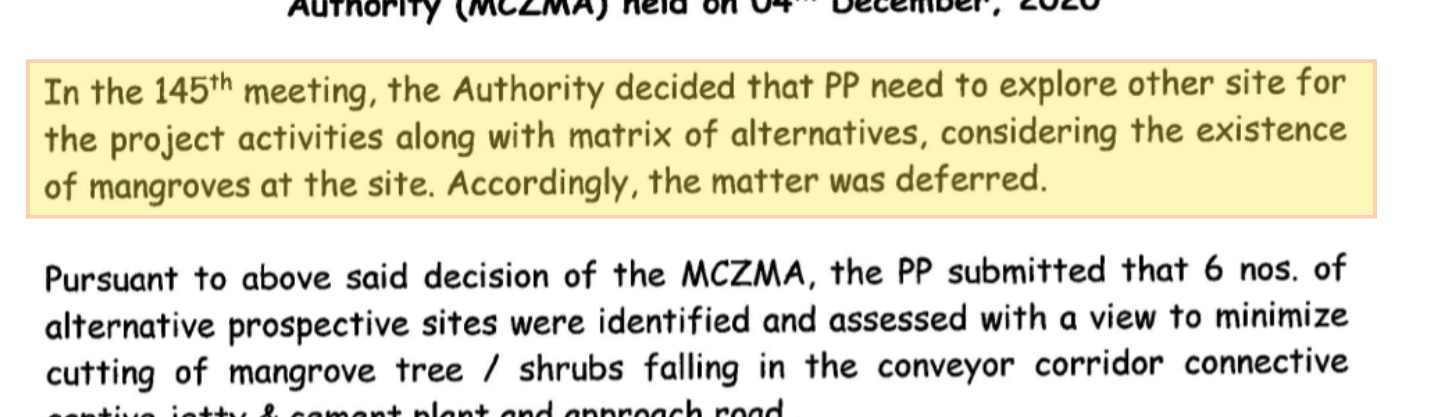
The coastal authority records its own July 2020 instruction. Minutes of its 149th meeting, 4 December 2020, page 14.
The company came back with six sites. Every one of them crossed mangrove reserved forest, for 410 to 650 metres, and the company ranked the shortest crossing first.
Five months after its instruction, on 4 December 2020, the same authority recommended the project to the ministry. The application the company filed later lists the very plots the mangrove cell had inspected.
The authority also took the company’s word on fishing. Citing the company’s study, it recorded that “there will not be any impact for fishermen”.
A hearing for each half
On 18 April 2022 villagers gathered in a hall at Poynad, in Alibag taluka, for the public hearing on the jetty. One of them objected that “two public hearings have been kept in a single day”. Project officers said the jetty application dated from 2018 and the cement one from 2021.
A speaker from Pen asked why the coastal authority had approved a site it once said the project should leave. The company’s own project officer confirmed the instruction. The authority had “directed us in its 145th meeting to think about other alternative sites”, he told the panel.
“There are not 150 mangroves, but 1,50,000 mangroves,” a man from Kamalpada said.
By the end of the day the panel held 190 written suggestions and objections. The convener sent them on with the minutes.
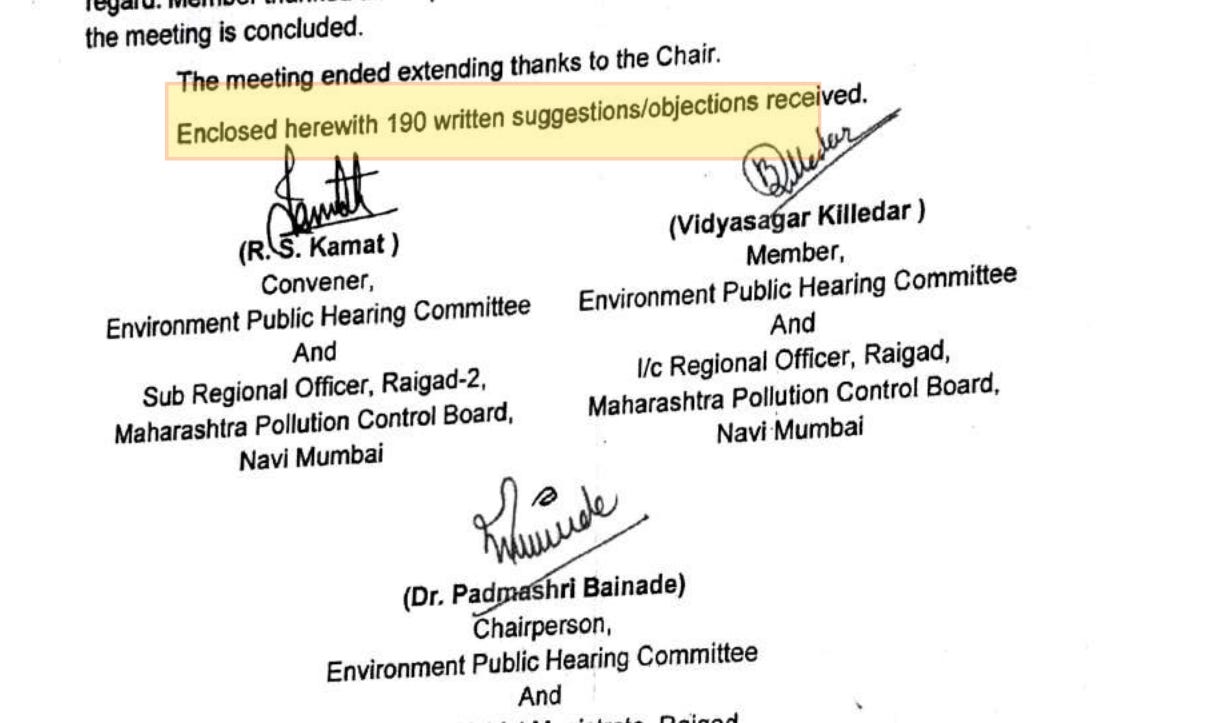
The count of written submissions, above the panel’s signatures. Public hearing minutes, 18 April 2022.
The company says it answered them in an annexure to its impact report. The plant’s committee later called its action plan on the hearing “satisfactory”.
Two letters, two sets of gaps
Dr Amardeep Raju, member secretary of the infrastructure committee, signed the jetty clearance. It allows about 158 trees to be affected and 60,000 cubic metres of dredging in the river, with up to 30,000 more if the berths silt up.
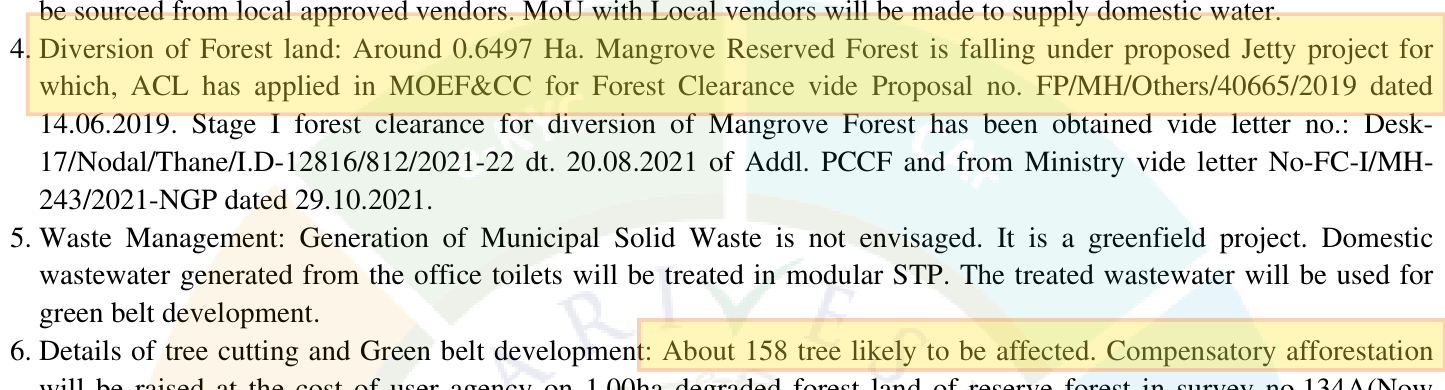
The jetty clearance of 29 December 2023 on the mangrove reserved forest and the trees, page 3.
Dinesh Runiwal, a ministry director, signed the plant clearance. It cites a 2010 ministry memo that lets each sector committee appraise its own part of a shared impact report. The split rests on that memo. The state authority had asked for a single appraisal of the whole.
The plant letter went out with large gaps. The project needed 10 hectares, of which the company held 3.24, and the other 6.76 “will be acquired soon”. The committee counted 13 highly protected species nearby and said the wildlife plan should be carried out “post approval”.
Two months later a corrigendum rewrote the letter. The plant’s cost rose from Rs 547.19 crore to Rs 990 crore, and its jobs fell from 900 to 415. The ministry called these “minor typographical errors”.
Cleared by the courts, still two files
To cut the mangroves, the company went to the Bombay High Court. The state and central authorities, the bench recorded, “have not opposed the Project”. The company’s own consultant had warned that cement and fly ash settling on the trees “may result in killing of the existing mangroves”.
The Bombay Environmental Action Group argued that a captive jetty serves one company. The bench was “not at all impressed”. Shipping cement by water, it held, would cut “carbon emission by more than 60%”. On 5 March 2025 it allowed 158 mangrove trees and shrubs to be cut.
The judgment describes the coastal authority’s July 2020 meeting as a request for documents. It does not mention the instruction to look for another site, or the state authority’s ruling that the jetty and plant were one project.
On 21 July 2025 the Supreme Court said it was “not inclined to interfere”, in a short order that gives no reasons. The final central forest approval followed on 24 October 2025, 11 days after the state filed its compliance report. In August 2026 the state forest department issued orders permitting the diversion, the Indian Express reported.
The company now wants its permits moved to a new name, Adani Cement Industries Ltd. On 5 September 2026 the state pollution board refused to move two of the site’s construction consents, because the certificate attached “does not reflect any change of name”.
The environmental clearances are travelling on two separate transfer files, one for the jetty and one for the plant. On 15 July 2026 the ministry’s portal showed both waiting on the company for more information, with no grant date.
The documents this story is based on, the clearances, orders, agendas and filings, are collected in one place.
→ The documents behind this story — add your DocumentCloud link