



Key findings
Fourteen forest approvals for Adani-linked projects in five states cover 11,421 hectares of forest land. Nearly 6,900 hectares are for coal mines.
At Mundra, Kutch’s forest chief wrote there was “no need” for more forest. The ministry approved 1,576.81 hectares in 2018, without the limits its expert committee had set that January.
At Dhirauli, the ministry called a forest “such pristine area” in February 2024. It gave final approval for a coal mine there in May 2025.
In Hasdeo in 2011, a minister overruled the expert committee that did “not recommend the diversion”.
On 16 November 2018, the environment ministry in Delhi gave in-principle approval to divert 1,576.81 hectares of reserved forest at Mundra, on the Kutch coast. The land was for an industrial park inside the special economic zone of Adani Ports and Special Economic Zone.
But the forest department in Kutch had already said there was no need. Its chief conservator wrote that the company “has already diverted the reserved forest of 2008.41 ha for the same cause”. So, he concluded, “there is no need for any diversion of forest land for the same cause”.
Those 2,008.41 hectares had gone to the company in a final approval of 30 September 2009. It was then still called Mundra Port and Special Economic Zone.
He also asked that 394.10 hectares at Siracha be left out, as “the unique prominent Acacia nilotica forest in the district”. The state government had asked to keep 100 hectares there for birds and wolves. When ministry officers inspected in 2017, the company said it wanted Siracha to expand its power plant. The officers called it “good forest”, and recommended giving it anyway.

The Kutch forest chief’s recommendation, quoted in the ministry’s 2018 file note on the Mundra proposal: no need for more forest, and keep Siracha’s Acacia forest out.
The two Mundra approvals are the largest of 14 forest approvals for Adani-linked projects, traced through the government’s own letters. Together they cover 11,421 hectares in Gujarat, Chhattisgarh, Madhya Pradesh, Maharashtra and Jharkhand, from 2009 to July 2026, our analysis shows.
Nearly 6,900 of those hectares are for coal mines. About 7,500 were approved after Narendra Modi became prime minister in 2014. OCCRP has reported on the group’s “widely perceived closeness” to him.
The count is permission to clear, not trees already felled. It is also a floor. It leaves out approvals under 90 hectares, and mines where no document shows Adani’s role.
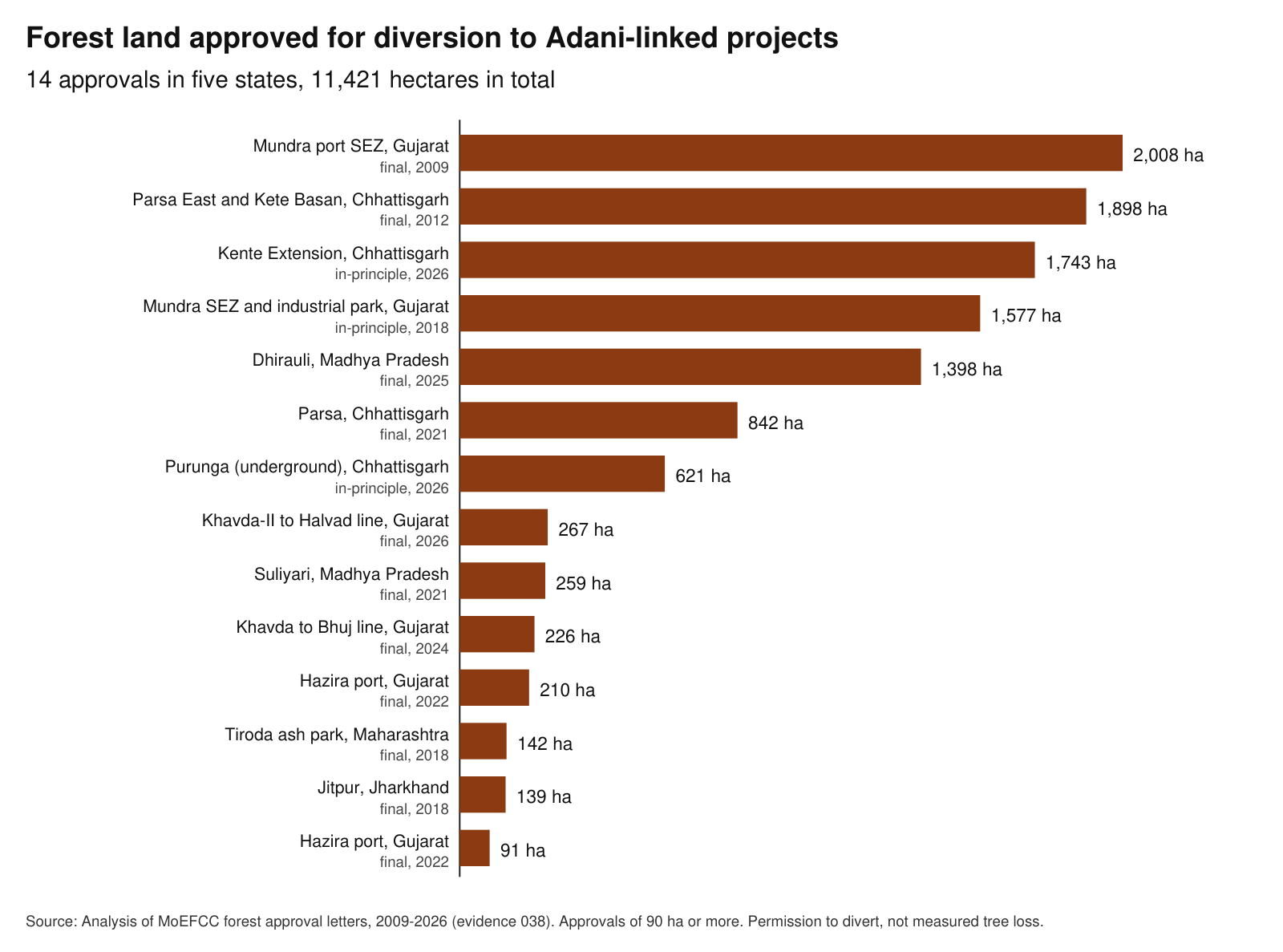
Forest land approved for diversion to Adani-linked projects, by approval. Source: our analysis of the ministry’s approval letters.
“No need for any diversion”
The Mundra file shows how far the ministry moved. In 2016 its inspectors found no plan showing what the forest was for. So they could not establish whether the company had sought the “bare minimum”. The district collector’s certificate on forest dwellers’ rights had not been furnished.
The proposal, from 2004, counted 579,497 trees to be felled. Most of the growth was Prosopis juliflora, an invasive weed from Mexico, the inspectors noted.
In January 2018 the Forest Advisory Committee, the ministry’s expert panel, recommended 1,552.81 hectares, not the full area. It said the diverted land “shall be maintained as green area”, with any other use decided case by case by the ministry. It noted from satellite analysis that an aerodrome “already exists in the zone”. Most of the forest and revenue land was already in non-forest use, it found.
The company then asked the ministry to delete or amend the committee’s conditions. It wanted the green-area condition rewritten, so that the land “shall be utilized for various industrial activities”.
The November 2018 approval gave the full 1,576.81 hectares. The green-area condition was gone. In its place, vegetation could be cleared “as and when a specific project / industry is to come up in the SEZ”. The letter lists Siracha among the villages and sets no area aside there.
Seven years late
The approval had conditions, including compensatory planting on 3,154 hectares, double the forest taken. The state was to report them met before final approval.
In February 2026 the ministry wrote that the compliance report had arrived “nearly seven years after grant of approval”, beyond the approval’s five-year life. It also asked why planting land equal to the forest was offered, instead of double.
After the state replied in April, the ministry granted final approval for 235.46 hectares, and then for another 247.43.
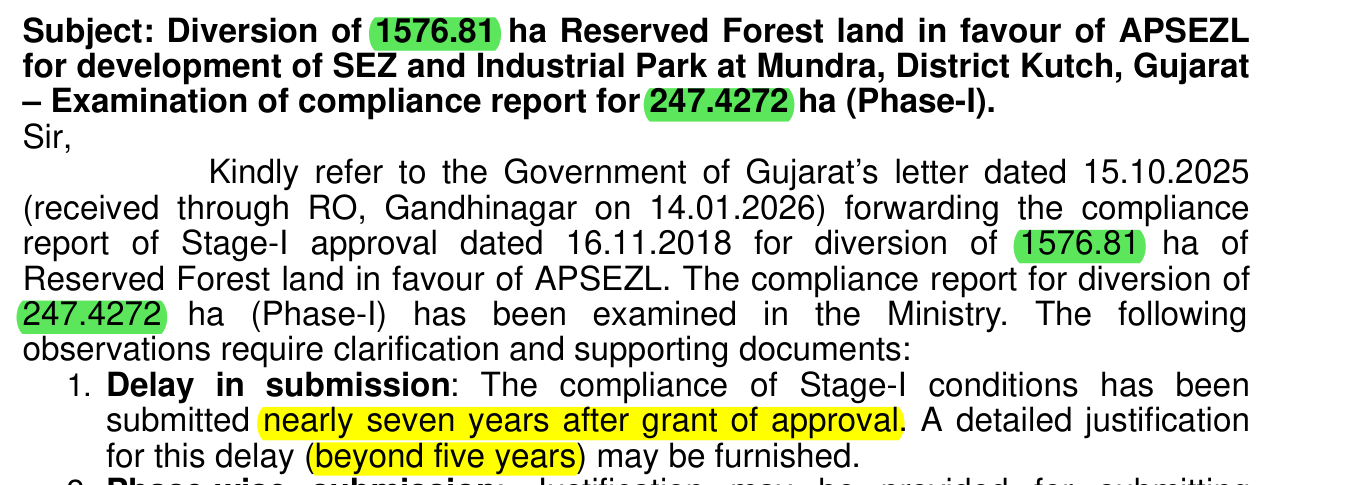
The ministry’s February 2026 letter on Mundra: the compliance report came “nearly seven years after grant of approval”.
“Such pristine area”
The same pattern runs through the coal belt of central India. In February 2024 the ministry wrote to Madhya Pradesh about the Dhirauli coal mine in Singrauli. Its own mapping found 1,601 hectares of forest in the lease, not the 1,397.54 proposed. The state had told it the site lay within a kilometre of an elephant corridor.
It estimated that 570,666 trees would be affected. Most of the land was very dense forest, and the ministry asked the state to justify proposing “such pristine area”.
In-principle approval followed on 24 September 2024. Final approval came on 9 May 2025, four days after the state’s compliance letter. In August 2025 the approval passed to Mahan Energen, whose letterhead gives Adani Corporate House, Ahmedabad.
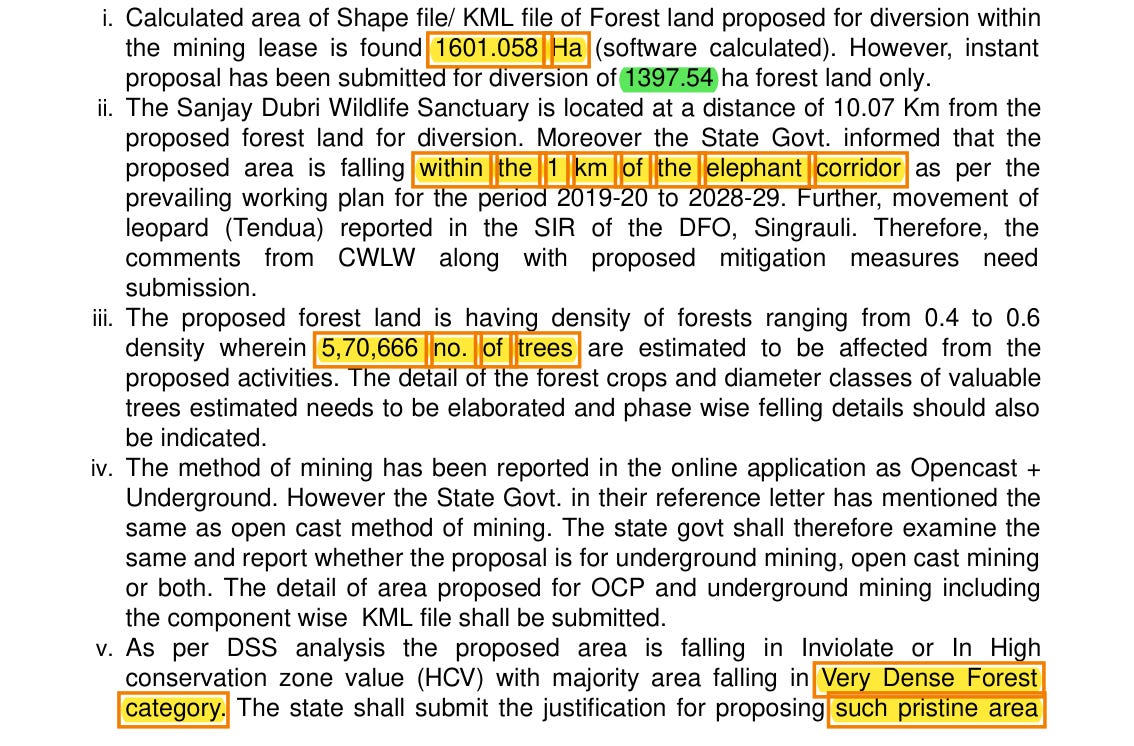
The ministry’s February 2024 letter on Dhirauli: 1,601 hectares of mapped forest, an elephant corridor, 570,666 trees and “such pristine area”.
In Hasdeo, Chhattisgarh, the ministry’s experts had said no outright. In June 2011 the Forest Advisory Committee recorded sloth bear, leopard and elephants at the Parsa East and Kete Basan block, and forest rights unsettled. It did “not recommend the diversion”.
On 23 June 2011 the minister overruled it, saying he had to keep the “development picture in mind”. Final approval for 1,898.328 hectares came in March 2012. The mine is run by a company 74% owned by Adani Enterprises.
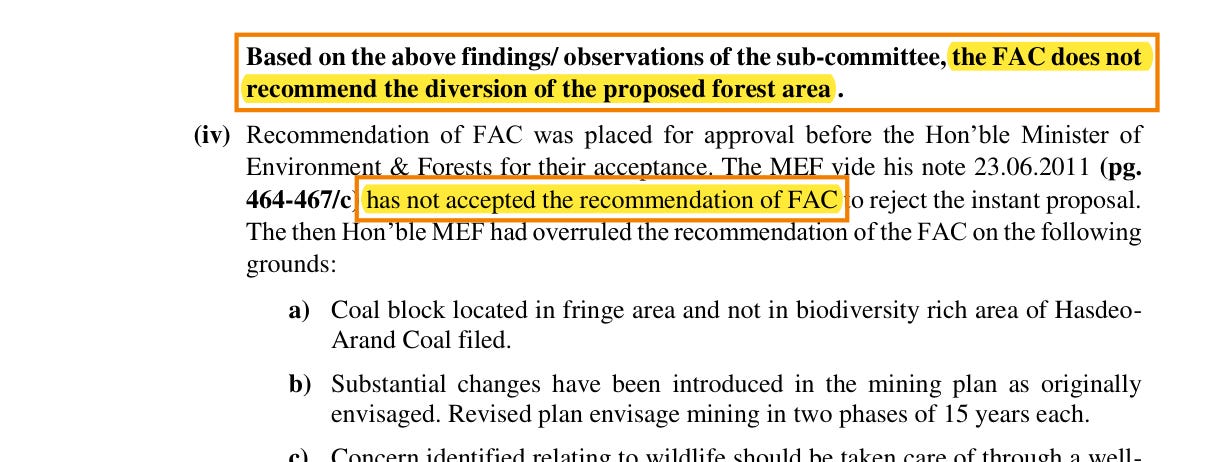
The ministry’s own file note: the Forest Advisory Committee “does not recommend the diversion”, and the minister “has not accepted” that advice.
Next door, Parsa received final approval for 841.538 hectares on 21 October 2021. Two days later the Governor of Chhattisgarh ordered an inquiry into allegedly fake village assembly resolutions for it, petitioners told the Supreme Court.
In Ghatbarra, a village on the edge of the first mine, community forest rights were cancelled in 2016. The reason, the villagers’ petition says, was that they “are interrupting in mining work”.
The approvals have not slowed. Kente Extension, in Surguja, won in-principle approval for 1,742.6 hectares of forest on 9 June 2026. On 23 July 2026 Purunga, an underground coal mine in Raigarh, won it for 621.331 hectares of forest, though surface rights cover only 9.982 hectares. The applicant is Ambuja Cements, whose filings give Adani Corporate House as its registered office.
On the coast, the record shows a safeguard can work. At Hazira, near Surat, mangroves found in the land Adani’s port company sought were left out before the 2022 approvals. From Khavda in Kutch, two Adani transmission lines got 493 hectares of forest land. For the newer line, 261 of its 267 hectares lie in the Banni Grassland forest division.
The ground gets hotter
Forests cool the land around them. Trees pull water from the soil and evaporate it, which carries heat away from the ground.
A 2019 study measured this from satellites across the globe. In the tropics, 5 km squares that lost about half their forest warmed at the surface by 1.08°C on average. That is the heat of ground and canopy as a satellite sees it, an average, not a measurement at any one mine.
Forests also make rain. A 2023 study in Nature looked across the tropics. Over areas of 200 km, each percentage point of forest lost cut rainfall by 0.25 mm a month. India is already hotter: 2024 was its warmest year since national records began in 1901.
There is an innocent reading. Ports, power and coal are lawful projects, and the approvals order compensatory planting, as Mundra’s did. Much of the Mundra forest was invasive weed. In 2023 the Adani Group pledged to grow 100 million trees by 2030.
But the objections in these files came from the government’s own officers and experts, and each time the approval went ahead.
In the ministry’s posted documents, 1,093.92 hectares of the 2018 Mundra approval are still waiting for their final letter.
The documents this story is based on, the clearances, orders, agendas and filings, are collected in one place.
→ The documents behind this story — add your DocumentCloud link