


Key findings
Two Adani data centre parks for Google’s AI hub were cleared nine days after the companies applied.
The forest officer’s no-objection for the Tarluvada site is dated 8 April, the day before the application.
The state’s expert committee recorded about 90% of that site as reserve forest, and recommended clearance at the same meeting.
Both parks were filed as buildings, each just under the size ceiling of a class that needs no impact report and no public hearing.
On 18 April 2026, S Sri Saravanan put his digital signature on two environmental clearances. He is member secretary of Andhra Pradesh’s State Environment Impact Assessment Authority. The clearances went to two Adani companies building the data centres of Google’s AI hub outside Visakhapatnam, each park described as 1,000 MW. The companies had applied nine days earlier, on 9 April.
But one paper in the Tarluvada file is older than the application. The minutes of the state’s expert committee, copied into the clearance, record a forest no-objection certificate from the Divisional Forest Officer, Visakhapatnam, for 266.60 acres of the site. It is dated 8 April.
Just above it, the same minutes record what the committee saw when it checked PARIVESH, the Union environment ministry’s clearance portal. “Approximately 90% of the proposed site falls within the Pedda Chukka Konda Reserve Forest,” they say. The next sentence says the Survey of India map shows no forest on the land. The minutes never say which record the committee believed. It recommended clearance at that meeting, one day after the applications came in.
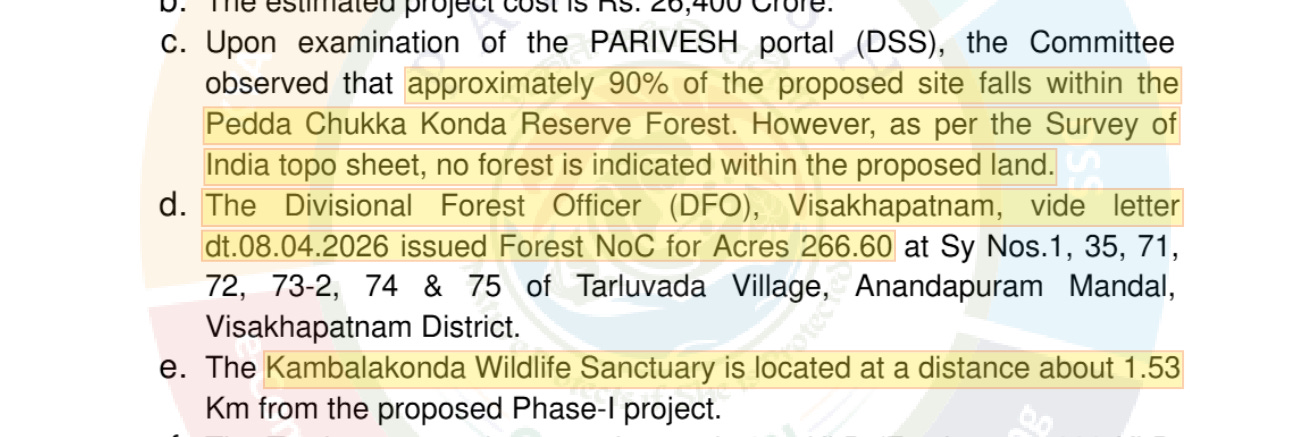
Page 4 of the Tarluvada clearance: the committee’s reserve forest finding, and the forest officer’s certificate dated 8 April 2026.
The applicants were not ordinary. Adani Enterprises and Google announced the hub in October 2025, about $15 billion, to be built with AdaniConneX, Adani’s data centre venture. The group’s chairman, Gautam Adani, was an early supporter of Narendra Modi’s political aspirations, CNBC reported. Chandrababu Naidu’s government in Andhra Pradesh is allied with Modi’s party.
The state is paying for the hub too. Its package for Google, tax breaks and cheap land, power and water, is estimated at Rs 22,000 crore over 20 years, the Guardian reported. At Tarluvada, 520 families have lost plots the government allotted them about 20 years ago. By September bulldozers had stripped the hillside near the village of its trees, and the paper put the forest to be cleared for the project at more than 100 acres.
Nine days
The land moved first. APIIC, the state’s industrial corporation, provisionally allotted 266.60 acres at Tarluvada to the Adani subsidiary on 20 February, and the full price had been paid by 27 February. The forest officer’s certificate followed on 8 April.
On 9 April both companies applied online. The same day, the committee drew up an “additional agenda” that put both projects before it the next morning. On 10 April Pridhvi Envirotech, a Hyderabad consultant, presented both, and the committee recommended both.
On 15 April the authority accepted the recommendations, and on 18 April Saravanan signed. Ten days later Google broke ground, and Naidu laid the foundation stone with Union IT minister Ashwini Vaishnaw.
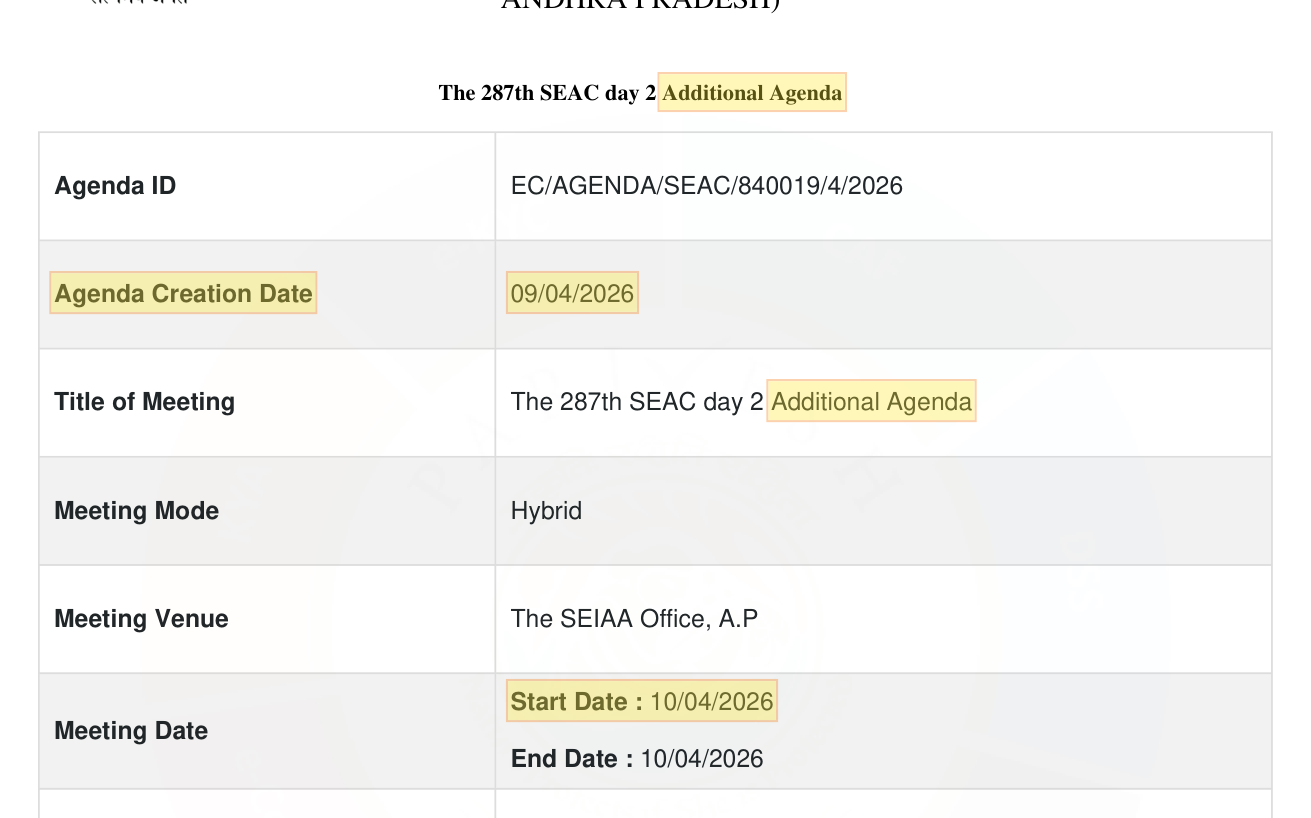
The committee’s additional agenda, created on 9 April 2026, the day the companies applied, for a meeting on 10 April.
The rules give the committee up to 60 days to appraise a project like this, and the authority up to 45 more to decide. Andhra Pradesh used one day and five.
Other files waited their turn. Of the 26 items on the authority’s 15 April agenda, 23 had been filed in earlier months, one of them in 2022. Only three dated from April 2026: the two Adani parks and a solar factory. The hub’s third site, at Adavivaram, applied on 24 April and was cleared on 10 June, after 47 days.
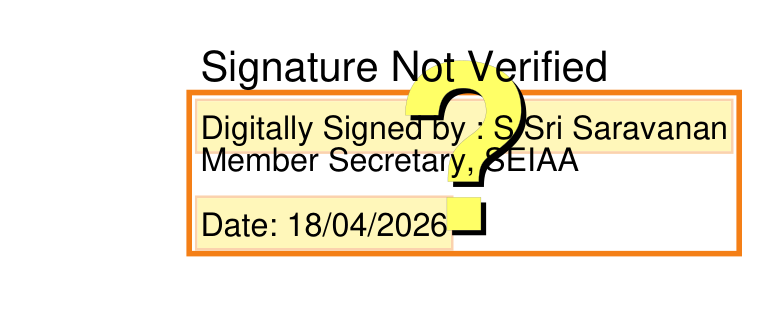
S Sri Saravanan’s digital signature on the Tarluvada clearance, dated 18 April 2026 (page 17).
Filed as buildings
Both parks went in as “building and construction” projects, a class for built-up areas between 20,000 and 150,000 square metres. Tarluvada declared 148,922 square metres and Rambilli 148,476, each within about 1,500 square metres of the ceiling. Projects in this class need no environmental impact report and no public hearing.
Data centres have no category of their own, and the state later told the High Court that was why it used this one, LawChakra reported. So two parks drawing 1,626 MW from the state grid between them were appraised as buildings. Tarluvada lists 200 diesel generators as backup, Rambilli another 150.
The committee wrote down the limits of its own review. It “appraised the application from the Environmental point of view only with respect to liquid, solid and air pollution management.”
The water budget was drawn to the same scale. Tarluvada declared 267 kilolitres a day, and the consultant’s slides show it was built from drinking and flushing water for 785 staff, guards and visitors, plus equipment cleaning and gardens. Google says the hub will be cooled by air. Permission to draw groundwater was left for later, to be “obtained” before construction or operation.
What the committee wrote about the forest
The consultant’s slides describe the Tarluvada land as “undulated terrain with trees, herbs, shrubs, and grass”, with a hill, Chukka Konda, on its western side. A photograph in the same deck, stamped 27 February, shows scrub and trees below the hills.
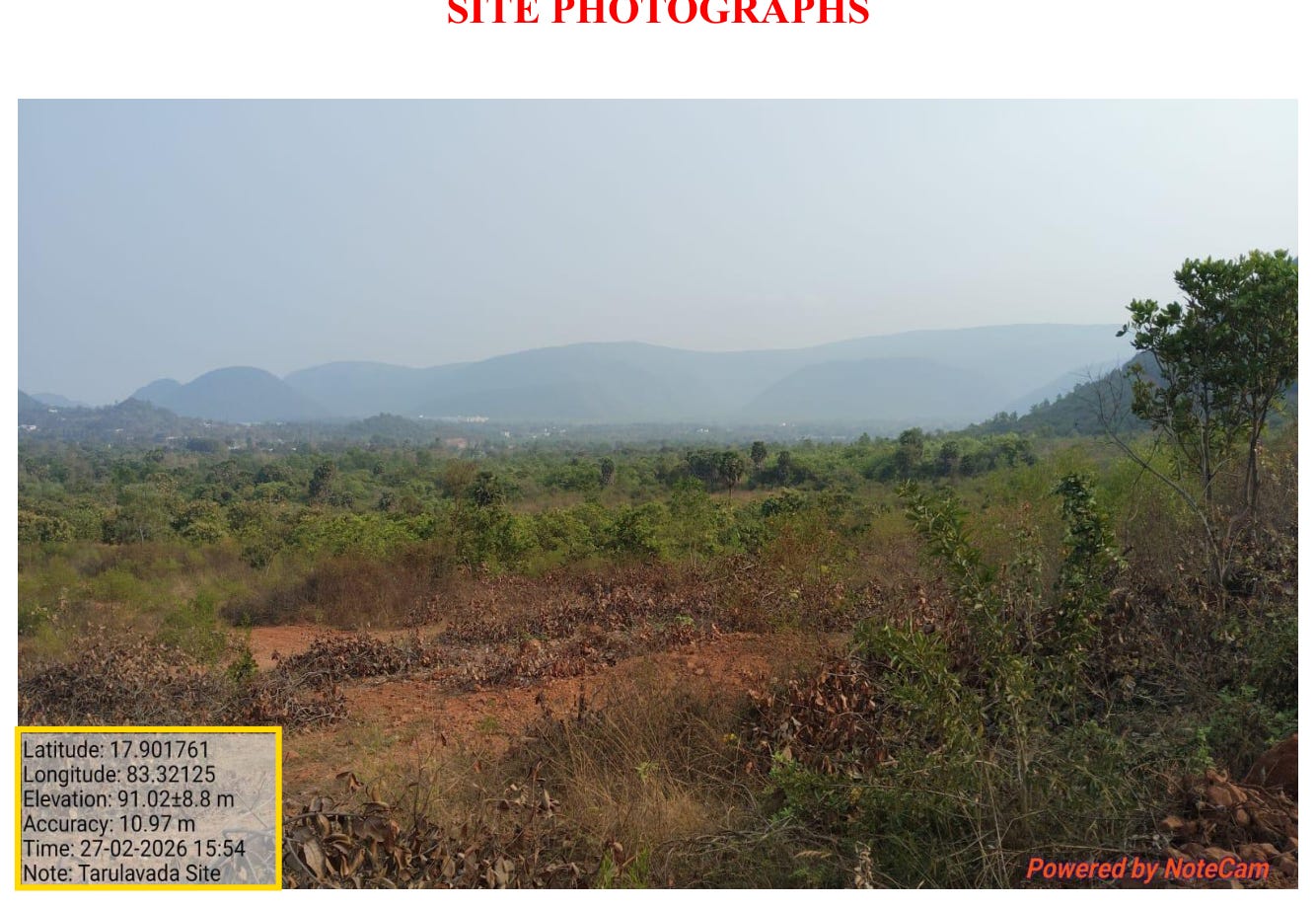
The consultant’s photograph of the Tarluvada site, stamped 27 February 2026, from its presentation to the state committee.
The slides name three forests near the site: Kambalakonda reserve forest, 1.7 km to the south, and two farther off. Pedda Chukka Konda is not among them. The reserve forest entered the record when the committee checked the federal portal at its 10 April meeting.
The minutes also place Kambalakonda Wildlife Sanctuary about 1.53 km from the first phase. The clearance answers the forest and the sanctuary with general instructions: obey the forest and wildlife laws, and “scrupulously comply” with the conditions of the forest officer’s certificate.
The Adani group says all legal approvals were given. Google told the Guardian it had “engaged deeply” with local communities and that the project would have “no expected impact” on them. Neither statement addresses the reserve forest the committee recorded at Tarluvada.
Before the tribunal
The order names two ways it can be undone. An appeal lies with the National Green Tribunal, within 30 days. The authority itself may cancel the clearance at any time if it was obtained “through suppression of any information or furnishing false information”.
Human Rights Forum has gone to the tribunal, calling the state’s risk assessment “grossly inadequate, scientifically unrealistic, and misleading”, the Guardian reported. The Andhra Pradesh High Court has declined to stay construction, LawChakra reported.
A separate appeal against the Adavivaram clearance says that site lies about 750 metres from the Kambalakonda sanctuary. The tribunal has asked the Union government to respond, and listed the appeal for hearing on 26 October 2026.
On the forest, the Tarluvada clearance leans on the officer’s certificate of 8 April. It does not reproduce the certificate or list its conditions, only its acreage and its date, the day before the companies applied.
The documents this story is based on, the clearances, orders, agendas and filings, are collected in one place.
→ The documents behind this story — add your DocumentCloud link